











Calorie Calculator: How to Calculate Your Calorie Needs
Calorie calculator
Introduction
For many athletes, it has become increasingly popular to "track" the calories consumed daily. But how do you actually know how many calories the body needs for muscle building or fat loss? To estimate this calorie consumption, you can use so-called "calorie calculators." Rocka Nutrition also offers a calorie calculator. Today's blog will focus on these calculators and their reliability.

Calorie needs - how much energy does the body require?
First, some basic terminology and a possible calculation example are explained for better understanding of how the calorie calculator works. BMI is generally well applicable in recreational sports for assessing weight (see Table 1). Body weight in an adult should remain constant within the recommended range (normal range: 18.5-24.9 kg/m2), but depending on body structure, it should be critically evaluated. Additionally, calculating total energy expenditure can provide an approximate indication of individual energy needs. The calculation is as follows: total energy expenditure = basal + activity expenditure (work, leisure, and training).
Table 1: Weight classification based on BMI (modified after [12])
|
Weight category |
BMI (in kg/m2) |
|
Underweight |
· <18.5 |
|
Normal weight |
· 18,5-24,9 |
|
Overweight |
· 25-29,9 |
|
Obesity |
· ≥30 |
The basal metabolic rate (BMR) is the energy expenditure of a person to maintain all bodily functions. The BMR can be estimated using the rule of thumb of 1 kcal/kg body weight/hour for men and 0.9 kcal/kg body weight/hour for women and serves as a guideline [3]. For somewhat more accurate estimates of a person's BMR, the calculation according to Harris and Benedict from 1919 can be used (see the following Table 2).
Table 2: Calculating basal metabolic rate according to Harris and Benedict (1919)
|
Male |
|
BMR (kcal/day) = 66 + (13.8 x weight [kg]) + (5.0 x height [cm]) – (6.8 x age [Jahre]) |
|
Female |
|
BMR (kcal/day) = 655 + (9.5 x weight [kg]) + (1.9 x height [cm]) – (4.7 x age [Jahre]) |
The physical activity level (Physical Activity Level [PAL]) implies the additional energy requirement for special physical/physiological activities. To account for the increased energy expenditure, the BMR is multiplied by the PAL factor [9]. The following table shows some examples of average daily energy expenditures for different occupational and leisure activities.
Table 3: PAL values for different occupational and leisure activities of adults (modified after [3])
|
workload and leisure behavior |
PAL factor |
examples |
|
below basal metabolic rate |
0,95 |
sleep |
|
exclusively sedentary/lying lifestyle |
1,2 |
elderly, frail people |
|
exclusively sedentary activity, few or no strenuous leisure activities |
1,4-1,5 |
office work, precision mechanics |
|
sedentary activity + occasional energy expenditure for walking or standing activities |
1,6-1,7 |
laboratory technicians, drivers, students, assembly line work |
|
predominantly walking or standing activity |
1,8-1,9 |
salespeople, waiters, mechanics, craftsmen |
|
physically demanding occupational activity |
2,0-2,4 |
construction workers, farmers, forest or mountain workers, athletes |
For physical activity (30-60 min per session, 4 to 5 times per week), an additional 0.3 PAL units per day can be added [3]. Kreider et al. [7] summarized the energy expenditure flat-rate for the recreational athlete (see Table 4).
Table 4: Flat-rate energy expenditure for the recreational athlete (modified after [7])
|
|
recreational athlete/fitness athlete |
|
training volume |
approx. 30-40 min/session, 3 sessions/week |
|
energy/day |
25-35 kcal/kg BW (approx. 1800-2400 kcal/day for an athlete weighing 50-80 kg) |
|
energy/training/hour |
approx. 200-400 kcal |
For competitive recreational athletes, it is recommended to determine a sport-specific consumption (training expenditure) due to higher workloads (see Table 5). The respective PAL value must then be subtracted from the training expenditure, as the specific sport is now performed instead of everyday activity [9].
Table 5: Calorie consumption for various sports per hour (modified after [10])
|
energy expenditure per hour and kg body weight |
type of physical activity |
|
6-7 kcal/kg/h |
Canoeing, badminton, tennis |
|
8-9 kcal/kg/h |
Horseback riding, strength training, hockey, soccer, basketball, aerobics |
|
10-11 kcal/kg/h |
Dancing, swimming, judo |
|
12-13 kcal/kg/h |
Running (5 min/km), cycling (35 km/h), boxing, squash |
The following is an example calculation for an office worker: An office worker (23 years old, 1.70 m tall, and 60 kg) performs an exclusively sedentary job (8 hours). In her free time, she also mostly sits and only stands occasionally. Additionally, she does strength training 3 times a week for 60 minutes each session, so 0.1 is added to her PALLeisure value for each hour of sport (3 x 0.1 = 0.3). Her average sleep duration is 8 hours. Thus, 8 hours (24 hours – 8 hours work – 8 hours sleep) are allocated to leisure activities.
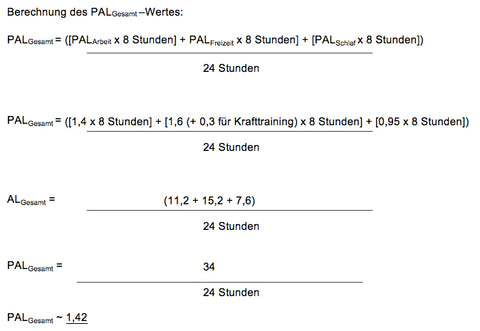
Basal metabolic rate (according to Harris and Benedict, 1919):
BMR: 655 + (9.5 x 60 kg) + (1.9 x 170 cm) – (4.7 x 23 years) = 1,440 kcal
Formula for individual total energy requirement:
Total energy requirement = Basal metabolic rate x PAL total value
= 1,440 kcal x 1.42 = 2044 kcal per day
How meaningful is this total value now?
The calculated value can be seen as a guideline but only provides a rough estimate. The formula tends to overestimate calorie needs – especially in overweight individuals. Therefore, it should be viewed as a reference for a specific period, for example, 2-4 weeks, during which weight and body measurements are regularly monitored. This way, you avoid an unwanted outcome if you have perhaps been too generous with calories. Energy needs are met when body mass shows only minor fluctuations over a relatively long period. Depending on the exact goals, the calculated numbers can be adjusted to specific targets in the further course:
- to build (lean) mass: add about 10-20% to the calorie value determined above
- to reduce (fat) mass: subtract about 10-20% from the calorie value determined above

What exactly is a calorie? And how do deviations occur?
A calorie is the amount of energy required to raise the temperature of one gram of water by 1 degree Celsius [13]. This fundamentally does not change regardless of which energy-providing substance the calorie is derived from (see Table 6).
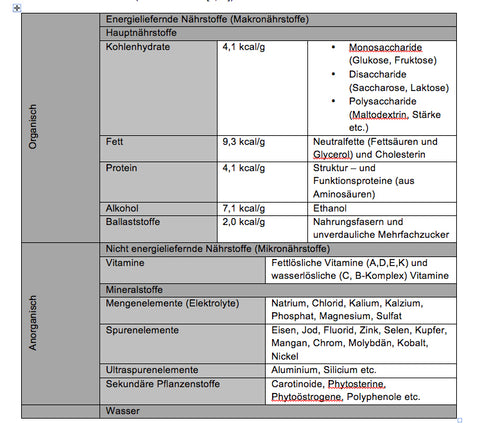
This often leads to the following idea: that one can achieve the same weight gain or an equivalent weight loss with 2 identical hypercaloric or hypocaloric diets regardless of the macronutrient composition. However, the difference is how the body handles the calories consumed. After food intake, the body fundamentally requires more energy due to the subsequent metabolic processes to make the ingested meal usable [8]. Each of these three macronutrients therefore not only provides energy to the organism but also consumes energy during the necessary processes, which is released as heat. This effect is called diet-induced thermogenesis or the "thermic effect of food" (TEF). The TEF differs for the three nutrients mentioned [6].
- Protein (20-30%)
- Carbohydrates (4-8%)
- Fat (2-4%)
With proteins, this effect can even last up to 18 hours, as the basal metabolism requires more energy to maintain a protein-rich diet than a fat- or carbohydrate-based diet [4]. Furthermore, it should not go unmentioned that besides the TEF, there are other mechanisms in the body that can lead to increased thermogenesis:
- Involuntary short-term muscle activities (non-exercise activity thermogenesis, NEAT), such as constant fidgeting, squirming, or permanent restlessness,
- Caffeine, green tea,
- Smoking (nicotine) as well as
- (Pathologically) elevated levels of thyroid hormones

What does this mean for practice?
For example, if you consume 2000 calories purely in the form of proteins, compared to 2000 calories purely in the form of carbohydrates. With the protein variant, 1400 calories remain from the 2000 calories (assuming 30 percent), which the body can actually use. With the carbohydrate variant, it would be more than 1800 calories that the body can still use. Besides the higher satiety effect and the positive nitrogen balance, a protein-rich diet during a calorie-reduced diet therefore makes sense to utilize the TEF. However, in a bulking phase, this effect can be disadvantageous, so protein intake should be significantly reduced and only meet the requirement [1].

Fitness watch – a meaningful alternative to the calorie calculator?
Calorie trackers are often mentioned in this context, which are supposed to measure calorie consumption more accurately. Fitness watches are now available in abundance and can be found in every price range with the greatest technical sophistication. But how accurate are they really? This question was investigated by Wallen et al. (2016). The results are relatively sobering and show that the watches are merely expensive heart rate monitors, as only the measurement of pulse or heart rate was reliable according to the results [11]. It is different when it comes to measuring energy expenditure. Deviations from the actual energy expenditure can be up to 43%. Such enormous measurement errors can, of course, have significant effects on the end goal. Another study that dealt with fitness watches found that the highest error rates occurred during individual activities – especially strength training [2].
Since watches also cannot capture the adaptability and changes of metabolism, biometric data as well as exercise duration and pulse are not sufficient to adequately assess energy metabolism.
Macros & Micros
In conclusion, it should not be overlooked that regardless of whether you determine your daily needs with a calorie calculator app or an online calorie counter, the non-energy-providing nutrients in the form of vitamins, minerals, and water play a significant role. For example, the largest amount of carbohydrates would be relatively ineffective if there is not enough potassium available to store glycogen in the muscles [5], or if vitamin B1, which acts as a coenzyme and is crucial for carbohydrate metabolism, is missing [4]. Thus, any diet would be ineffective despite meticulous adherence to exact macronutrient intake. Therefore, in today's IIFYM era, micronutrients should not be neglected just because they do not provide direct calories.
Conclusion
This leads to the conclusion that the energy calculator provides a good guideline for calorie needs. Regardless of how complex the formula used to program the calculator is, adjustments are often necessary afterward. However, the calorie calculator from Rocka Nutrition offers a solid basis for determining an effective calorie amount. Therefore, it should be seen as a reference value for a specific period (2-4 weeks). During this time, both weight and body measurements should be regularly monitored so that daily calorie needs can be adjusted in time.
References
1: Antonio, J., Peacock, C.A., Ellerbroek, A., Fromhoff, B. & Silver, T. (2014). The effects of consuming a high protein diet (4.4 g/kg/d) on body composition in resistance-trained individuals. Journal of the International Society of Sports Nutrition, 11, 19.2: Bai, Y., Welk, G.J., Nam, Y.H., Lee, J.A., Lee, J.-M., Kim, Y. et al. (2016). Comparison of Consumer and Research Monitors under Semistructured Settings. Medicine and Science in Sports and Exercise, 48 (1), 151–158.
3: German Nutrition Society [DGE], Austrian Nutrition Society [ÖGE], Swiss Society for Nutrition Research [SGE] & Swiss Association for Nutrition [SVE]. (2013). Reference Values for Nutrient Intake (1st ed., 5th revised reprint). Neustadt an der Weinstraße: Umschau.
4: Geiss, K. R. & Hamm, M. (2000). Handbook of Athlete Nutrition (2nd ed.). Behr's: Hamburg.
5: Hahn, A., Ströhle, A. & Wolters, M. (2005). Nutrition. Physiological Basics, Prevention, Therapy. Stuttgart: Scientific Publishing Company.
6: Jéquier, E. (2002). Pathways to obesity. International Journal of Obesity and Related Metabolic Disorders: Journal of the International Association for the Study of Obesity, 26 Suppl 2, S12–17.
7: Kreider, R.B., Wilborn, C.D., Taylor, L., Campbell, B., Almada, A.L., Collins, R. et al. (2010). ISSN exercise & sport nutrition review: research & recommendations. Journal of the International Society of Sports Nutrition, 7 (1), 7.
8: Kreymann, K. (2004). Energy Balance. In H. K. Biesalski & Bischoff, S. C. & Puchstein, C. (Eds.), Nutritional Medicine. According to the Curriculum Nutritional Medicine of the German Medical Association (3rd ed., pp. 37–38). Stuttgart: Thieme.
9: Raschka, C. & Ruf, S. (2015). Sport and Nutrition: Scientifically Based Recommendations, Tips, and Nutrition Plans for Practice (2nd ed.). Stuttgart: Thieme.
10: Schek, A. (2013). Nutrition in Top-Level Sports: Current Guidelines for Peak Performance. Wiesbaden: Umschau Zeitschriftenverlag.
11: Wallen, M.P., Gomersall, S.R., Keating, S.E., Wisløff, U. & Coombes, J.S. (2016). Accuracy of Heart Rate Watches: Implications for Weight Management. PloS One, 11 (5), e0154420.
12: World Health Organization. (2000). The problem of overweight and obesity. In World Health Organisation (Ed.), Obesity: preventing and managing the global epidemic: report of a WHO consultation. Geneva (pp. 5-37): World Health Organization.
13: Berg, J.M., Tymoczko, J.L. & Stryer, L. (2009). Stryer Biochemistry. (B. Häcker, A. Held, C. Lange, K. Mahlke, G. Maxam, L. Seidler et al., Trans.). (6th ed. 2007, corrected reprint 2010). Heidelberg et al.: Spektrum Akademischer Verlag.