








L-CARNITINE - THE FAT BURNER
L-Carnitine – real fat burner or just an empty advertising promise?
Weight loss or body fat reduction is a ubiquitous topic across all sports. Anyone who has ever strictly dieted knows how exhausting and nerve-wracking such a diet can be. Ideally, you want to reach your desired result as quickly as possible. How convenient would it be to accelerate this process by taking so-called fat burners? In this context, the name L-Carnitine often comes up. But can the claimed effect of L-Carnitine really be confirmed due to its metabolic effects?
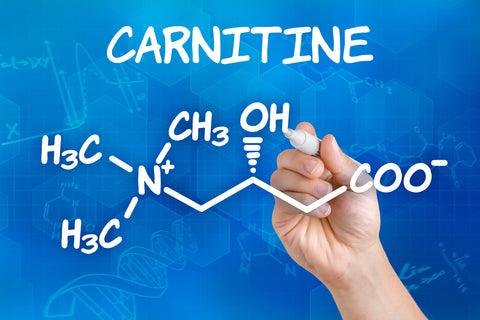
What is L-Carnitine?
L-Carnitine is an amino acid compound. The human body has two ways to meet the need for L-Carnitine, formerly known as Vitamin BT. On the one hand, it can produce L-Carnitine endogenously from the essential amino acids lysine and methionine [7]. Another prerequisite for endogenous synthesis is the presence of numerous cofactors such as vitamin C, niacin, vitamin B6, and the trace element iron [12]. This way, the body covers about 25% of the daily requirement, whereas vegetarians can provide up to 90% through endogenous synthesis [14]. Therefore, L-Carnitine is not considered essential.
In addition to endogenous synthesis, the intake of L-Carnitine through food is important to maintain an optimal supply status. Animal products are the most important sources (see Table 1).
L-Carnitine is found in the following foods:
Table 1: L-Carnitine content in certain foods (modified after [10])
|
Food |
Occurrence |
Amount (mg/100g) |
|
Meat |
Sheep |
210 |
|
Lamb |
80 |
|
|
Beef |
60 |
|
|
Other foods |
Yeast |
2,4 |
|
Milk |
2,0 |
|
|
Eggs |
0,8 |
|
|
Cereal products |
Wheat germ |
1,0 |
|
Bread |
0,2 |
|
|
Vegetables |
Avocado |
1,3 |
|
Cauliflower |
0,1 |
In total, about 15-20 g of L-Carnitine is stored in the human body. By far the largest proportion is found in the muscles, especially in the heart muscle (about 98%) [10].
What does L-Carnitine do?
The effects of L-Carnitine in the human body can roughly be divided into three categories:
- Effects on the utilization of carbohydrates, fats, and proteins
- Protection of cell membranes and intracellular membranes
- Neurological effects in the central and peripheral nervous system
Metabolically, almost exclusively the L-configuration of carnitine is active. In addition to the free form, it also exists in the organism as short- and long-chain acylcarnitine. However, today's blog will primarily focus on the physiological functions of fat metabolism in connection with the amino acid-like compound. L-Carnitine is therefore [4]:
- Biocarrier for the transport of long-chain fatty acids into the mitochondria
- Component of some enzymes located in the mitochondria
One of the main tasks of L-Carnitine is therefore the transport of activated long-chain fatty acids into the mitochondria, the so-called power plants of the cells, where the fatty acids are broken down for energy production (ß-oxidation). Carnitine itself is then transported back and can be used for further transport processes. This means that the carnitine itself is not consumed in the process [11].
The key enzyme in fat burning is carnitine palmitoyltransferase 1 (CPT 1). CPT 1 links L-Carnitine with a fatty acid before its transport into the mitochondrion. According to current knowledge, the activity of this enzyme represents the limiting step for fat oxidation [6].
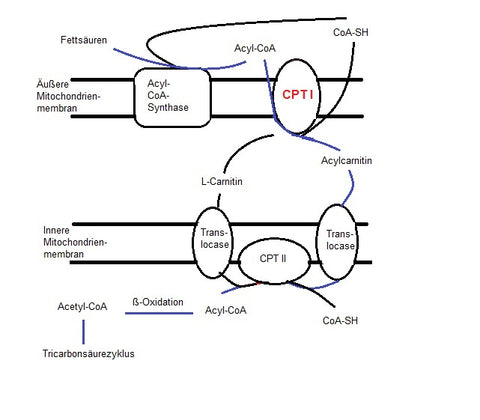
Fig. 1: Diagram of the transport of long-chain fatty acids mediated by L-Carnitine from the cytoplasm into the mitochondrial matrix (modified after [9])
Derived effect on L-Carnitine fat burning
Claimed effect: The intake of additional carnitine supplements is said to lead to increased fatty acid burning. Therefore, L-Carnitine is often marketed as a so-called fat burner. However, the described mode of action could not be confirmed in most studies.
H5 Scientific arguments against taking L-Carnitine as a fat burner:
- In energy production from fat, the capacity of the aerobic enzyme system and the corresponding availability of oxygen are crucial. However, these parameters can be optimized through targeted endurance training (but not by using Carnitine) [8, 13].
- The speed of the carnitine-dependent fatty acid transporter is already operating at maximum speed and therefore cannot be increased [2].
- L-Carnitine is not consumed during fatty acid transport but regenerates and is thus available again for the transport cycle. -> Therefore, with a mixed diet, additional supplementation is not necessary [5, 7]!
- Increased intake raises the carnitine level in the blood, but the total carnitine concentration in skeletal muscle remains completely unaffected [2].
When maintaining maintenance calories or a calorie surplus and/or physical inactivity, an increase in fat burning through L-Carnitine supplementation does not occur [3, 5].
An increase in the activity of the limiting enzyme CPT 1 can only be promoted, for example, through endurance sports, low-carbohydrate diets, or calorie-reduced diets [8]. In this case, there is the possibility of losing excess fat with sufficient L-Carnitine. It is therefore a misconception that fat loss in physically inactive people is stimulated solely by increased L-Carnitine intake, since fatty acids must first be supplied to the muscle from the fat tissue [9].
Thus, taking L-Carnitine alone for weight loss will not have an increased effect on fat burning unless additional necessary behavioral changes are made [1].
Possible L-Carnitine Side Effects
Supplementation of L-Carnitine at doses of 1-2 g per day is considered absolutely safe [7]. However, higher doses above 5g/day should be avoided, as limited absorption capacity in the intestine can lead to gastrointestinal problems as a side effect [10].
Conclusion
The desired effect regarding weight loss through the intake of L-Carnitine unfortunately does not occur according to current studies. The only effective method – what a surprise – is therefore to promote a negative energy balance through the targeted combination of exercise and nutrition. However, there are now many other considerations as to whether supplementation with L-Carnitine contributes to improved performance and enhanced recovery.
References:
1: Benvenga, S. (2005). Effects of L-carnitine on thyroid hormone metabolism and on physical exercise tolerance. Hormone and Metabolic Research = Hormon- Und Stoffwechselforschung = Hormones Et Métabolisme, 37 (9), 566–571.2: Burke, L. & Deakin, V. (2006). Clinical Sports Nutrition (3rd edition). Sydney; New York: McGraw-Hill Medical.
3: Decombaz, J., Deriaz, O., Acheson, K., Gmuender, B. & Jequier, E. (1993). Effect of L-carnitine on submaximal exercise metabolism after depletion of muscle glycogen. Medicine and Science in Sports and Exercise, 25 (6), 733–740.
4: Hahn, A., Wolters, M. & Hülsmann, O. (2006). Dietary Supplements: and Complementary Balanced Diets (2nd edition). Stuttgart: Wissenschaftliche Verlagsgesellschaft.
5: Heinonen, O.J. (1996). Carnitine and physical exercise. Sports Medicine (Auckland, N.Z.), 22 (2), 109–132.
6: Heinrich, P.C., Müller, M. & Graeve, L. (2014). Löffler/Petrides Biochemistry and Pathobiochemistry (9th edition). Springer.
7: Kanter, M. & Williams, M. (1995). Antioxidants Carnitine and choline as putative ergogenic aids. International Journal of Sports Nutrition, 5, 120–131.
8: Lee, J.S., Bruce, C.R., Spriet, L.L. & Hawley, J.A. (2001). Interaction of diet and training on endurance performance in rats. Experimental Physiology, 86 (4), 499–508.
9: Luppa, D. (2004). Involvement of L-Carnitine in the Regulation of Fat and Carbohydrate Metabolism. Klin Sportmed 5, 25-34.
10: Neumann, G. (2014). Nutrition in Sport. Meyer & Meyer Verlag.
11: Raschka, C. & Ruf, S. (2015). Sport and Nutrition: Scientifically Based Recommendations, Tips, and Nutrition Plans for Practice (2nd edition). Stuttgart et al.: Thieme.
12: Rebouche, C.J. (1991). Ascorbic acid and carnitine biosynthesis. The American Journal of Clinical Nutrition, 54 (6 Suppl), 1147S–1152S.
13: Schek, A. (2013). Nutrition in Top Sports: Current Guidelines for Peak Performance (1st edition). Sulzbach (Taunus): Umschau Zeitschriftenverlag.
14: Vaz, F.M. & Wanders, R.J.A. (2002). Carnitine biosynthesis in mammals. The Biochemical Journal, 361 (Pt 3), 417–429.
15: Villani, R.G., Gannon, J., Self, M. & Rich, P.A. (2000). L-Carnitine supplementation combined with aerobic training does not promote weight loss in moderately obese women. International Journal of Sport Nutrition and Exercise Metabolism, 10 (2), 199–207.